


The Season that was.

March to August, again.
There was genuine uncertainty around how Essendon’s 2026 would unfold, with hope, promise and potential all mixed together over the summer break.
Another five new draftees joined the 10 additions from the previous two years, while a host of players returned from long-term injuries. Then there was the question of the locker room, with the captain forced to stay after wanting out, and a coach in a make-or-break fourth year in charge needing it all to work cohesively on field, with what looked like a system change over the preseason.
Unfortunately, by the end, we had our answer. It would go down in the record books as the worst season in the club’s 129-year history.
The build up.
Early in 2025, there were signs of a shift in the team’s ideology and method, with the game built more around supporting the source with numbers before exiting by hand to generate run, rather than kicking its way forward.
After injuries took too big a hold from the midway point of that season, the approach became a messy mixture of the early-season style and a contrast of going longer and much more direct by foot than in recent years.
That looked to be the default for 2026 based on what was being shown through preseason training.
Pre-Christmas drills focused on speeding up decision-making, both in who to move the ball onto and how to do it, before taking it much further down the ground. In theory, it was simple and uncomplicated, but one that placed significant demands on the group.
Quick thinking came first, followed by the work rate to support it.
All up, the game should have looked noticeably faster with ball in hand than Essendon had played under the Brad Scott regime, with more chaos and support at the drop of the ball, while maintaining constant structure ahead to target.
Ideally, this would allow the Bombers to outnumber the opposition, or at worst have even numbers, with less congestion giving players more room to show their strengths in leg speed and ball winning.
It looked similar, with slight variations, to what Adelaide, Collingwood and Gold Coast had produced the previous season, and Geelong and Port Adelaide in seasons before.
The footnote was that this did not guarantee success on its own.
Many elements needed to come together to make it effective, and it did not take long to see one key ingredient missing: speed through the lineup and list.
There was also an obvious disconnect when it came to transferring what had been taught and learned on the training track into the real stuff.
Let’s begin.
An extremely tough start was always on the cards, coming up against preliminary finalist Hawthorn in Round 1.
They looked solid and confident in what they wanted their game to look like with ball in hand, something completely opposite to Essendon.
By half-time, the Bombers had been unable to replicate their take-territory-and-go-forward attack, once again finding themselves over possessing by hand and simply referring the pressure applied to them onto teammates in positions that were never going to be able to handle it.
Just over 50% of disposals went by foot to the main break, and it got worse in the third quarter, with 53 handballs to only 46 kicks.
A reality check in Round 1 was not how Essendon wanted to start the next six months.
A trip to Adelaide to face the Power, who had been humbled by North Melbourne by 46 points a week earlier, provided an early opportunity for Essendon to show it could quickly readjust. Instead, it only added more concerns.
Two goals to 10 in the opening half primarily came down to an inability to stand up to the pressure when in possession, with over-handballing under that heat rightly punished on the scoreboard through turnovers.
The next four quarters in Round 3 against North Melbourne and the opening half against the Western Bulldogs were just as damning in showing both the players’ ability to replicate what had been trained and the coaches’ ability to teach it.
What are we doing?
The change rooms at half-time against the Bulldogs, with Essendon down 13 to 67, would have had some interesting conversations.
What followed on field was a complete 180, with the trial of a new Essendon abandoned in favour of a previous version of themselves.
After the restart, the handball-heavy approach became a much more controlled style.
In their first 14 quarters of 2026, Essendon had a kick percentage of just 54.11%, at the time the second lowest in the competition, with only Gold Coast ranked below. Even Sydney, under its new system of forward handball, run and carry, kicked it more.

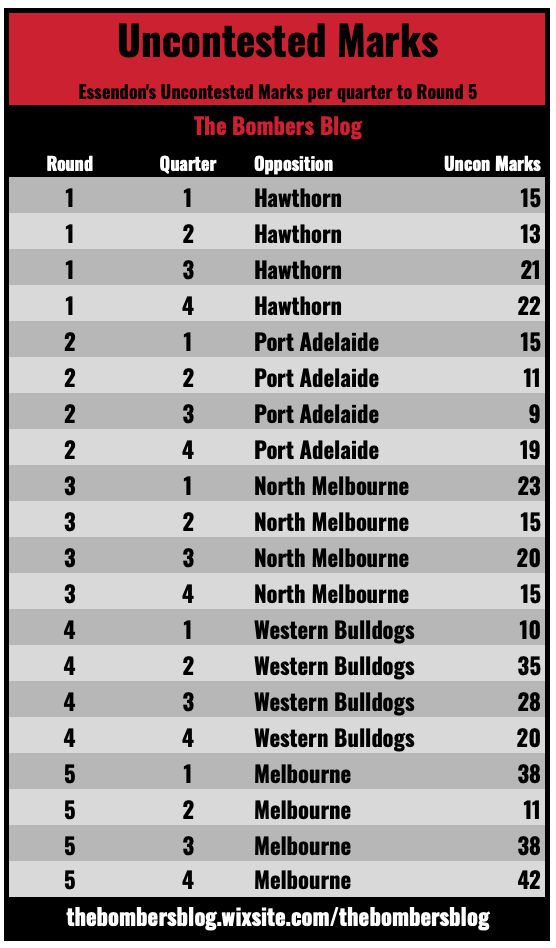
But in the final 40 minutes against the Bulldogs, the Bombers went by foot more than 62% of the time, allowing them to find 48 uncontested marks, well up on the 32 they had averaged per half in their previous three games.
With confidence regained, they headed to Gather Round, where the control method continued.

It’s been a long time.
Melbourne came into the matchup having won three of four, scoring more than 100 points in each victory.
They were the fifth-equal highest-scoring team, fourth for converting turnovers into scores and second for turning a possession chain started in defensive 50 into a score.
All of that becomes difficult if you cannot get your hands on the ball.
At quarter-time, Essendon had taken 38 uncontested marks, their highest in any quarter since the beginning of 2025, with more than 64% of disposals coming by foot as they slowly and methodically worked their way forward while denying Melbourne enough opportunities the other way.
By the end of the game, the Bombers had finished +57 in uncontested marks and +99 in uncontested possessions, with a kick percentage of 61.6%.
They finally snapped an equal club-record 17-game losing streak with a 45-point victory, their biggest win since Round 11, 2023.
The success was reward and relief after what had been the most difficult period of the majority of the playing list’s careers.

With that came a more significant challenge at the time: the second-highest scoring team in the competition and a side that played the most chaotic game style itself, while also demanding it from its opponents, Gold Coast.
A better future.
For all the positives of the Round 5 victory, it was not a style I believed would deliver reliable long-term success.
Even though Essendon would not come away with the four points against the Suns, the process and performance should shape what was to come once Essendon was finally straightened up.
Faster ball movement with a direct line to goal, fewer marks needed than groundballs won, and high transition scoring from turnovers were all basic elements of a contested battle and all that would be expected in September.

In my view, Essendon’s showings against Gold Coast, and GWS in Rounds 9 and 19, are the blueprint.
Across those three games, Essendon had their most one-on-ones in the front half, with 17 in Round 9 and 15 in Rounds 6 and 19, well up on their season average of nine across their other 20 games.
They also had their highest percentage of possession chains started from intercepts, while in two of the three games, Rounds 6 and 9, they had their third and fourth-highest shot totals from opposition turnovers.

On Broadway again.
Back-to-back scores of more than 100 points in Rounds 5 and 6, the first time since Rounds 1 and 2 the previous year, meant the majority of Bombers fans would have fancied their chances in the annual Anzac Day clash.
But the stage proved too big for the inexperienced lineup as the game went on, and that continued into the following week against the dual reigning premiers.
Fremantle packed far too many punches in Round 10, before Essendon had an opportunity in Dreamtime to put some space between themselves in 17th and Richmond in 18th.
Lose this, and rightly, Brad Scott’s future would be questioned.
It’s over.
Twelve minutes into the game, Essendon was already two rotations down, and by 12 minutes into the second quarter, Sam Durham and Matt Guelfi had been joined on the sidelines by Andrew McGrath and Jye Caldwell.
Caldwell would return heavily restricted and be consigned to playing inside 50, testing not only the mettle of the players on field, but also those upstairs.
By the end, the Bombers had run out of puff.
Four days later, so had Scott.
Only one win in 24 games was obviously a poor look. The frustration among Essendon fans had grown with what they were seeing on field, while more and more were staying away from games.
But ultimately, in my view, it was the growing doubt over whether Scott was capable of turning the long-term vision everyone had originally been aligned to into a team capable of consistently competing against the best that cost him his job.
Essendon had invested heavily at the draft in developing the next generation, and the expectation was that Scott would be the coach to bring that development together with a game that could stand up over the long term.
From my perspective, the decision itself was justified.
While there were occasional signs of improvement over Scott’s three-and-a-half years, the fundamentals never improved enough.
Readers and subscribers know too well the defensive issues I had unfortunately written about regularly, including opposition transition from defensive 50 to inside 50, opposition scores per inside 50, intercepts per opposition possession and points against from turnovers.
But now Essendon’s only facet of the game that had been working, with the football, had become just as much of a disaster.
There will be no question from me about whether it was the right choice to move on Scott, with all the past and present evidence on hand, along with the doubts about the future. What remained more debatable was the timing.
That showed in the next three weeks, as the same decision could have been made with far less disruption during Essendon’s mid-season bye, rather than leaving those remaining to pick up the pieces and scramble to manage both coaching changes and on-field priorities simultaneously, with a trip to Perth against the Eagles, the traditional King’s Birthday Eve clash against arch-rival Carlton and the return bout against Melbourne.
A short term voice.
Finally, the refresh came and the message became about being “gritty, not pretty” for the back nine of the year. This had multiple meanings.
A hard-fought loss to North Melbourne preceded back-to-back thumpings to St Kilda and Brisbane away, with the Saints’ preseason performance two weeks out from Round 1 showing Essendon to be true to form.
But seven days later, after what felt like the most troubling period in the club’s history on field, somehow the players and coaches who stuck around were rewarded for doing so through the freefall.
One more time.
Once again, the speed on the ball through the high-turnover game style from GWS played into Essendon’s hands, just as it almost had in Round 9.
This time, with a little luck, realistically a lot of luck through inaccuracy, the Bombers would sing the song for the second and last time in 2026, with four of their next five games against teams that would make their way to at least the second week of finals.

The other half of the game.
With the footy has had a slow makeover over the last couple of preseasons. Unfortunately, that has not been the case without it.
If there was one glaring missing aspect to early-season training, it was education around defensive structures and system, and six quarters into the year showed it best, or should I say worst.
As I stood out under minimal shade taking in the skills, drills and running over the summer build-up, I would have liked to see much more consistent development on defending.
There were plenty of contested drills, with players one-on-one wrestling before aerial battles, but very little on where to stand in an effective zone, or how to work as a team to communicate positioning and spacing in order to avoid being picked apart through uncontested marks and possessions, and ultimately halt ball movement.
By half-time against Port Adelaide, Essendon was conceding 35 uncontested marks a quarter, and that was still the case at the main change against the Western Bulldogs in Round 4.

If the chaos game suited the Bombers, the control version was truly the opposite.
It is no coincidence that four of Essendon’s five biggest defeats for the year, Hawthorn, Brisbane, Collingwood and St Kilda, came against four of the seven top-ranked sides for uncontested marks per game.

Far too often over the years, we have seen opposition move the ball unpressured from their own defensive 50 all the way to the other end.
No significant changes were made under Scott’s tenure.
Once the ball penetrated the Essendon press, there was nothing else behind it.
By the time Dean Solomon was appointed interim coach, there was little opportunity to make significant changes to the major defensive problems that had been at the root of Essendon’s performances.
Some may point fingers at him after he stepped into an assistant role as the defenders coach, but the issues stemmed much more from the team’s connections and structures than the individuals on the last line.
David Rath, who joined the coaching ranks in 2024 with experience in coaching innovation, was appointed game strategy manager and carries far more responsibility for Essendon showing no improvement in what makes up 50% of football.
When Rath was announced as part of Scott’s coaching team, there was much anticipation that he could transfer his past success at Hawthorn through their premiership run to Essendon, but ultimately, his three years will go down as bitterly disappointing.
The lineup.
There have been so many factors, particularly over the last 18 months, behind why performances on field have been so poor, with recurring injuries an obvious one that affects continuity and connection between each line and the players beside them in the lineup. List changes were another, with those changes gradually seeing Essendon become the youngest average weekly side as 2026 went on.
11 times this year, the Bombers would run out with the youngest selected side for the round, and another seven times as the second youngest. The oldest team came in back-to-back games against Fremantle and Richmond, where they were ranked 15th of all 18 teams, while Essendon was the youngest team in each of the final seven games of the season.
All five new draftees had been given senior exposure by Round 5, with eight of the 15 players aged 21 or under selected this year playing more than half of the season. This made Essendon the second-youngest average selected team to play since Adelaide 2022.

The shooting stars.
Essendon’s Pick 10 selection in last year’s draft, Jacob Farrow, would play 21 games for the year, with only Carlton’s Harry Dean and West Coast’s Willem Duursma playing more games in their first season of football. Dean was the only freshman to spend more total minutes on ground than Farrow, who in fact ranked sixth of all 41 Bombers for minutes played.
The smooth-moving left-footer showed everything that made him a wanted player from his 18th year and more, and with further development within himself, along with a welcome change to Essendon’s system of attack, 2027 should see another progression in how he uses the ball going forward, both figuratively and literally.
Essendon’s first selection in the 2025 draft, Sullivan Robey, had a slow start to his season, only beginning contested drills at training in late February, before his year ended early due to injury, with no further games after Round 20. But his impact in his 15 games, not just at Essendon but across the competition, was immense.
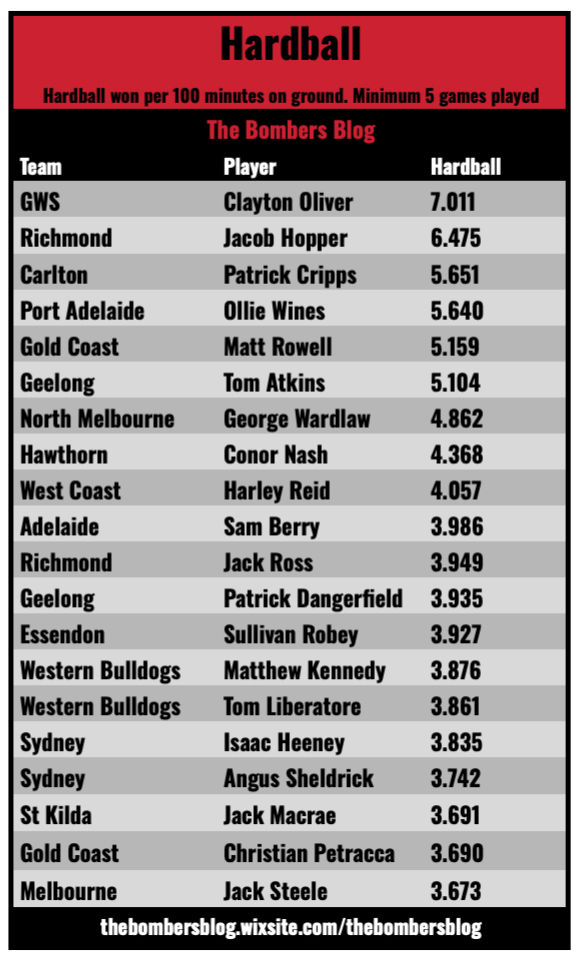
Of all 36 players in their first year of football, “Sully” ranked second for contested possessions per minutes played, and clearly number one for hardball, a disputed ball at ground level under direct physical pressure. The 19-year-old ranked 13th in the competition for this metric among all players to play more than five games for the year, behind names including Clayton Oliver, Patrick Cripps, Ollie Wines, Matt Rowell and Patrick Dangerfield.
With more outside hard-running midfield help coming through future drafts, Essendon can better capitalise on his ball winning pre-clearance in order to get much better value from his stoppage work.
The only player who won more contested footy per minutes on ground in their first season than Robey was Dyson Sharp.
Pick 13 Sharp was impressive from day one of preseason training, quickly showing his running abilities by finishing eighth in his first 2km time trial on his first day of training, and it didn’t take long for that to transfer to weekends.
Although he was hampered twice by contact injuries through the year, he was still able to play 15 games, including the last 10 after a shoulder injury, and finished the year averaging over 74% of Essendon’s centre ball ups in the last three games against mature bodies of Bailey Smith, Tom Atkins, Isaac Heeney, Errol Gulden and Ollie Wines at the coalface.
Like Robey, Sharp will be much more successful once Essendon builds a more balanced lineup of inside and outside midfielders who can complement their work.
Both Hussein El Achkar and Max Kondogiannis got valuable exposure at AFL level, playing nine and 15 games respectively, with runs of four and seven consecutive games. The two have much more improvement to come, but finishing their year in the back end of Essendon’s VFL finals run must give both the motivation heading into an important off-season and then into their second preseason.
The 2024 draft class also had an interrupted run. Isaac Kako made 15 appearances after playing all 23 last year, with Zak Johnson playing seven games, Angus Clarke six, Jayden Nguyen five and Rhys Unwin four, unable to either consistently find weekly form or continuity on the track.
One who did, though, was Archer Day-Wicks. After the limited exposure of five games last year, Day-Wicks was able to cement his spot in the lineup, playing the last 21 games, the equal third most by a second-year player, and rightfully earning selection through his defensive actions. In nine games he applied four or more effective tackles, with only Zach Merrett and Sam Durham having more.
Taken in last year’s mid-season draft, Archer May showed more than enough promise in the front half in his 10 games. The 22-year-old ranked 11th of all key forwards for contested marks and seventh for contested marks per minutes played before finishing his year too early.
Hopefully he pairs up for the next 10 years alongside Nate Caddy.

22 games this year, another step up from his 17 in his second year, saw Caddy kick 46 goals, with his 4.31 average shots at goal per game the fourth most of all 21-year-olds since 2012, with only Jeremy Cameron, Jake Stringer and Logan Morris averaging more across those 15 seasons. With a better accuracy rate helped by more consistency, less difficult shots at goal and more entries from his teammates down the ground, 13th in the Coleman Medal race can become top 10, eight or even higher in future years.
Strength and conditioning.
The future looks bright with the young brigade coming through from the last three drafts, but what would certainly help is having them play together more often week by week, without that being limited by injuries like in previous years. That seemed to be an improvement under the guidance of new fitness boss Matt Innes.
While Essendon still used 41 different players this year, the second most and only ahead of Richmond, it certainly wasn’t due to the same circumstances as last year, when they used 44.
Of course, luck plays a big part.
In his previous four seasons, Zach Reid had played just 19 games, with 10 the most in a single season and 10 the most consecutive, averaging just 59 minutes per game. This year, he played all 23, one of only two Bombers to do so. Of the 669 players in the competition, Reid ranked 21st for total minutes played. Such an enormous improvement should bring confidence going into 2027.

Four quarters of football.
Not much stood out more to Dons fans this year than slow starts, which immediately changed the way the game was going to be played.
This is not uncommon for a young and inexperienced side, but it is also a sign of coaching, which in this instance points mostly to poor preparation.
I would expect that most of the work done during the week would be centred on Essendon developing its own game, but more needed to be done in how that would be executed against what the opposition was likely to bring.
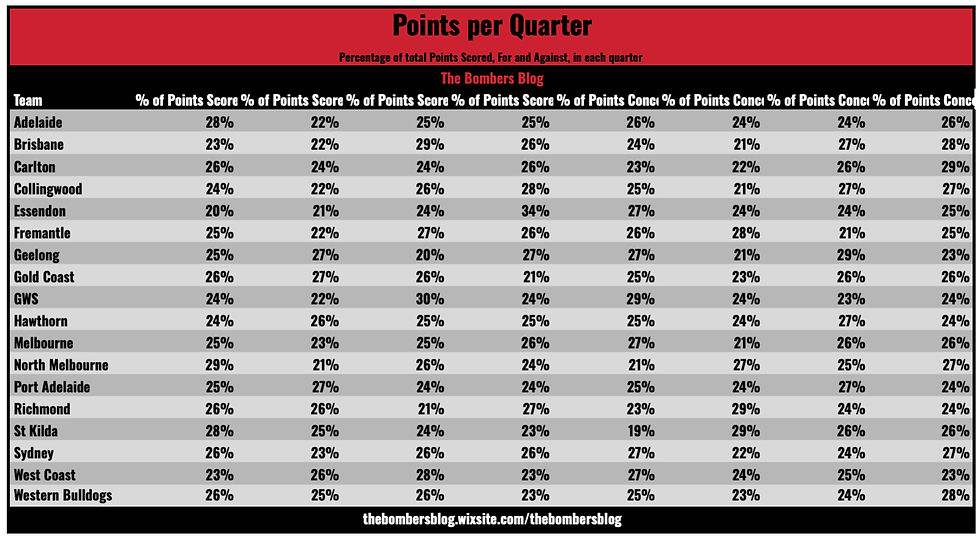
The Bombers would only lead at quarter time on three occasions, with an average points differential of just over 15 points, both clearly 18th in the competition. Only 20% of Essendon’s total scores came in the first 20 minutes of game time.
First halves weren’t much better, with their opposition averaging almost six more shots at goal by the main change.
By then, games were virtually over.
Thankfully, the majority of the time it was the next generation that fought out the games.
Quote taken from my review of Essendon versus Fremantle in Round 10
“Here, an 18-year-old in just his sixth game provided a glimpse of what Essendon hopes its future can become.
Sullivan Robey was part of Essendon’s centre-square rotations in the first half, attending six of the 13 ball ups without making a significant impact. However, after what appeared to be a change in instruction, he became the hit-to option underneath the ruck and brought about a change in how the game was being played.
Five clearances for the quarter, three from the centre square, all stemmed from Robey winning first possession and, just as importantly, denying Fremantle the same opportunity.
The groundball battle, both hardball and looseball, turned in this period as Essendon won both metrics by three and six respectively, after losing them by two and six in the first two quarters.
With that came a complete shift in scoring profile.
Fremantle went from 10 shots at goal from clearance in the first half to none in the third quarter, while Essendon generated more shots from stoppage in those 20 minutes than they had across the previous 40.
Territory and field position also flipped dramatically.
In the first half, Fremantle intercepted 18 Essendon rebound chains in their forward half as the Bombers attempted to move the ball out of defence, well above the Dockers season average. In the third quarter, they managed just one.
Essendon instead played the game almost entirely in its attacking half, denying Fremantle exit from defensive 50 on 11 occasions for the quarter alone after managing only eight for the entire first half.
By the end of the third term, Essendon had won contested possessions by eight after losing the first half by 18. Robey was central to the turnaround, winning seven of Essendon’s 36 contested possessions and starting six of their 26 possession chains himself, with four of the team’s 15 inside 50 entries for the quarter coming directly from his work.”
As most saw, if they stayed on or continued to watch, Essendon did most of its scoring in last quarters, with 34% of its points coming in this period, the largest percentage of any team this year.
Caddy would score 20 of his 46 goals in final quarters. If only Essendon could have supplied him with more opportunities earlier in the game.

Restarts.
The back half was under constant pressure all season, while the front half was restricted by limited supply, with both areas influenced far too much by what happened between the arcs, in defending transition, effective rebound and ball movement from stoppage.
First up, the centre square.
The high-leaping Lachie Blakiston’s preseason didn’t translate into effective ruck work once the real games began, while injury setbacks to Vigo Visentini and Nick Bryan, who was still building after recovering from the previous year, meant there were limited options available in the air to start 2026.
For Essendon’s first 10 games, they had a cumulative differential of -50 from the centre square, winning the head-to-head battle only twice, against Melbourne by one and the following week against Gold Coast by five.

Over the course of the season, this immediate difference in territory had the backline scrambling with even numbers, while limiting the forward line of the same luxury.
Last year, Essendon ranked 15th for centre clearance differential and 16th for converting a centre clearance into an inside 50. With a host of returning players this year, the hope would have been for a much better result. Unfortunately, things got worse, with the Bombers ranking 18th for winning the initial centre clearance and once again 16th for turning that into a forward 50 entry.
Conversely, they were punished the other way, with only GWS less effective at restricting opposition centre clearances from going inside 50, another poor return after Essendon ranked 18th in the same measure last year.
Only the Eagles gave up more points from this score source, while no team scored fewer than the Bombers. The better teams were able to hurt their opponents far more from centre clearance, with three of the four preliminary finalists, Brisbane, Sydney and Fremantle, ranked first, second and third by the end of the regular season.
Thankfully, there was a change in responsibilities, particularly after Essendon had a -62 cumulative differential in points across its first 10 games, with Jye Caldwell, Darcy Parish and Zach Merrett slowly and rightfully rotated out, while Sam Durham, Sullivan Robey and Dyson Sharp were afforded more opportunities.
Around the ground, stoppage clearances weren’t as big an issue over the course of the season, with Essendon finishing just above even, but there was too much inconsistency.
They lost the count by an average of 7.2 after the first four games, then won it by an average of 7.7 across the next four. From Round 12 onwards, the Bombers won this battle only four times, including by 18 and 16. Those two, skewing the overall numbers.
In both modes, the battle inside played an enormous part.
In to out.
Essendon won contested possession pre-clearance in nine games, with standout performances coming against Melbourne in Round 5 (+8), West Coast in Round 12 (+28) and GWS in Round 19 (+12). Despite this advantage, and sometimes domination, only against Melbourne were they able to outscore those teams by more than seven points from clearances. The other way doesn’t make for great reading, particularly against the best midfields, with Brisbane and Hawthorn punishing heavily when they won it, while the mid-table mixes of Sydney and Geelong were also too efficient.

Last year, Essendon ranked fourth for denying opponents from converting their first possession pre-clearance into an effective clearance, behind only Geelong, the Western Bulldogs and Brisbane. Their ability to either keep the ball in congestion and force a repeat stoppage, or better still, strip it from the opposition and turn it into a clearance themselves, was a key strength.
Unfortunately, they weren’t up to the same standard this year, ranking 11th and only slightly above the AFL average.
Once the ball was won by the opposition and then easily chained up on exit, too much ended on the scoreboard.
No team gave up more scoring shots from clearances than Essendon, while no team had a worse rate at defending a clearance loss turning into a score. Essendon was 2% worse than Richmond in 17th and 4% worse than West Coast in 16th.

Whether it is restarts at centre ball ups or stoppages around the ground, there needs to be a lot more education, development and situational training on how to set up both inside and outside in both ball-winning and defensive modes at stoppage.
Too many times, Essendon wasn’t able to maximise a first-possession read from the ruckman and then feed players outside, partly because of the limitations on the list that hopefully are on their way to being addressed at the draft, and partly because players chose to hack kick the ball forward for quick territory.
The goal should be a balance of ball-winning inside midfielders together with first-receive outside players who can take ground with run and carry, then have the time to assess what to do from there.
Defensive awareness through better positioning will force more “dirty ball” in congestion, with players holding better shape around the perimeter pre-clearance and providing more opportunities to tackle, something that must improve for 2027, or even better, intercept the ball back.
Essendon’s tackle numbers at the mid-season bye.
The other way.
The back third was overwhelmed in the early parts of the season, and then as the year went on, compromised, with first-choice key defender Ben McKay unable to deliver anything near expectations. But what would have undoubtedly helped was more assistance further up the ground.
Too much was expected of Essendon’s defenders in 2026.
First, they had to stand up in contests against their matchups, mainly in one-on-ones.
As has been the case post-COVID, Essendon was once again one of the easiest teams for opposition sides to move the ball from defensive 50 to inside forward 50 against. In fact, following on from last year, they were the easiest once again.
Inconsistent to poor system in ball movement, as I wrote earlier, played a significant part in shallow entries into the front third. That made rebounds too straightforward for the opposition, allowing them to hold teammates wide and switch to the opposite side from where the ball originated, leaving Essendon’s midfield with little chance to relocate an opponent.
When the defensive line was able to win the ball back through intercept, it meant scoring chains started so far from goal, obviously making scoring much more difficult.
But what was relied upon too heavily was the defenders rebuilding the territory lost without enough assistance in between.
Essendon’s midfield was almost non-existent in bridging the back half to the front half, providing far too little between the arcs for defenders to hand the ball over and then reset their positioning, while their teammates moved it forward the rest of the way. That would result in more meaningful, deeper inside 50s and make opposition transition much more difficult.

Some big-name midfield changes are inevitable for 2027, with high draft picks moved on due to limited development and improvement, while experienced players were slowly phased out this season or traded out for Essendon’s future.
The expectation is that newly appointed senior coach Mark McVeigh can instil a better system with the football that helps both phases of attack and defence, but the number one priority has to be improving the list that does the most work in this aspect of the game, the midfield.
The last two draft years have looked to target positions of need on the list, and that needs to once again be the case for Matt Rosa come November. But every resource available to Essendon also needs to be put into maximising and speeding up the development of the next generation.
There is a gap in experience and age profile that should also be prioritised during the trade period, with an emphasis on mature bodies that can fill the void while the draftees grow into senior football.
They can also bring the knowledge built over years to a list that desperately lacks leadership on and off the track.
Here we are again.
In some ways, the year Essendon had was not unexpected.
The competition is at its strongest and most professional right now, and any department within a football club that isn’t at the required level is quickly exposed.
Carryover injuries from last year were always going to play a part, while the captain’s request for a trade would certainly have raised questions between teammates in the locker room.
There had already been doubts about the coaching structure and its implementation from previous seasons, and in the end, all of these played their part in some way, along with a host of other factors, in 2026 becoming the disaster it was for everyone associated with Essendon.
Another reset was required.
But now it is time to put the last period out of everyone’s mind and start the build towards 2027 and beyond.
Go Bombers!


Comments