


Review

Who knows.
A much-improved showing last week followed two back-to-back disappointing performances, but what would Essendon produce this time against one of the benchmark teams of 2026?
Coming into this game, Essendon’s better displays have generally come against opponents that prefer a more chaos-based style with a higher handball-to-kick ratio, while their struggles have more often come against sides that control tempo and territory through uncontested marking.
Fremantle presented a variation of both this week, using kick-mark control in the back half before shifting into chaos mode forward of centre.
But before any method can be applied, what Fremantle first tests is an opposition’s ability to repeatedly stand up around the contest.
You’re going to earn it.
Coming into this clash, Fremantle games averaged the second-highest contested possession rate in the competition at 37.89%, behind only Adelaide. By comparison, Essendon games ranked second lowest at 32.95%.

Fremantle’s inside game demands genuine ball winners, averaging more than 44 hardball contests per game, while their 171 contests outside stoppage rank third in the AFL behind Sydney and Adelaide.

Knowing this and more, Essendon on Thursday night selected a 23 they believed was best suited to go head-to-head with Fremantle’s strengths around the ball and in the air.
Caleb Serong came into the game ranked 11th among midfielders for contested possessions, Neil Erasmus 20th for hardball gets, Andrew Brayshaw fourth of all players for effective tackles and Luke Jackson eighth.
Ahead of the ball, Josh Treacy, the number one player in the competition for both post-clearance contested possessions and contested marks, supported by a backline that allows the fewest one-on-one contests behind centre and loses the fourth-fewest of them in the AFL.
It was always going to be a significant challenge, particularly with the weather playing its part, and it didn’t take long for Fremantle to expose the areas Essendon needed to hold up in most.
Already in trouble.
Serong, Shai Bolton and Jackson did the damage pre-clearance, repeatedly turning first possession into territory.
Behind the ball, Jordan Clark and Liam Ryan cleaned up at ground level, but the real damage came forward of centre where Treacy and Voss combined for nine contested possessions. Treacy’s hands were again a feature, clunking two contested marks after winning two contested possessions in the opening 47 seconds alone.
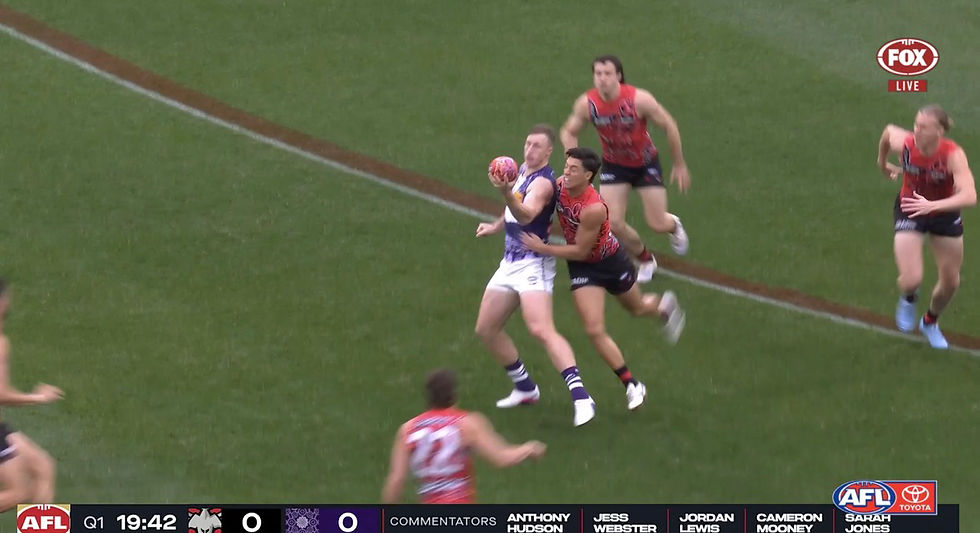
Josh Treacy’s ball winning ability draws five Essendon players to him, freeing up teammates on the outside. (Vision Fox Footy)
By quarter time, Fremantle had dominated the ball in dispute, finishing +14 in contested possessions. It was Essendon’s second-worst quarter differential since the beginning of 2025, behind only the third term on Anzac Day this year (-16).
Fremantle’s punishment from stoppage hurt most, converting more than 57% of clearance wins into scores, and the trend continued into the second term.
By half time, 40 of Fremantle’s 66 points had come from clearance, while Essendon could only manage three points from the same source despite trailing stoppages just 15–14.
But it was here that team selection showed its biggest issues.

Screenshot of my post on X (Twitter) after team selection was announced.
We had an inkling.
In an attempt to hunt the ground ball against the AFL’s second-best clearance differential side behind Brisbane, Essendon’s midfield was too often drawn into the congestion.
When they failed to deny first possession to Serong or Jackson, the imbalance on the outside was badly exposed.
Too many were sucked inside traffic, leaving Fremantle runners with space on the outside. From there, their leg speed forced Essendon defenders from proactive positioning into reactive defending.


Four Essendon players with all eyes on the ball and ball carrier, while two of their matchups hold space to receive. (Vision Fox Footy)
It is an issue that has existed within Essendon’s list profile for some time. More outside runners are needed, not only to hold width defensively, but also to provide damage if the inside work is won.
A half was in the books and Essendon had squandered enough opportunities in front of goal to at least keep the scoreboard respectable, but if there was any response to come against one of the competition’s best sides, it needed to begin with winning the dirty ball.
Here, an 18-year-old in just his sixth game provided a glimpse of what Essendon hopes its future can become.
Some big shoulders.
Sullivan Robey was part of Essendon’s centre-square rotations in the first half, attending six of the 13 ball ups without making a significant impact. However, after what appeared to be a change in instruction, he became the hit-to option underneath the ruck and brought about a change in how the game was being played.
Five clearances for the quarter, three from the centre square, all stemmed from Robey winning first possession and, just as importantly, denying Fremantle the same opportunity.
The groundball battle, both hardball and looseball, turned in this period as Essendon won both metrics by three and six respectively, after losing them by two and six in the first two quarters.
With that came a complete shift in scoring profile.
Fremantle went from 10 shots at goal from clearance in the first half to none in the third quarter, while Essendon generated more shots from stoppage in those 20 minutes than they had across the previous 40.
Territory and field position also flipped dramatically.
In the first half, Fremantle intercepted 18 Essendon rebound chains in their forward half as the Bombers attempted to move the ball out of defence, well above the Dockers season average. In the third quarter, they managed just one.
Essendon instead played the game almost entirely in its attacking half, denying Fremantle exit from defensive 50 on 11 occasions for the quarter alone after managing only eight for the entire first half.
By the end of the third term, Essendon had won contested possessions by eight after losing the first half by 18. Robey was central to the turnaround, winning seven of Essendon’s 36 contested possessions and starting six of their 26 possession chains himself, with four of the team’s 15 inside 50 entries for the quarter coming directly from his work.

He finished with 8.5 AFL Player Rating Points for the term, the fifth highest of any player in the third quarter this round and the 25th highest across the round overall, despite being the youngest and least experienced player in that top 25.
It was as impressive a 20 minutes as you could ask for from someone so early in their career, particularly from a player who already looks highly coachable.
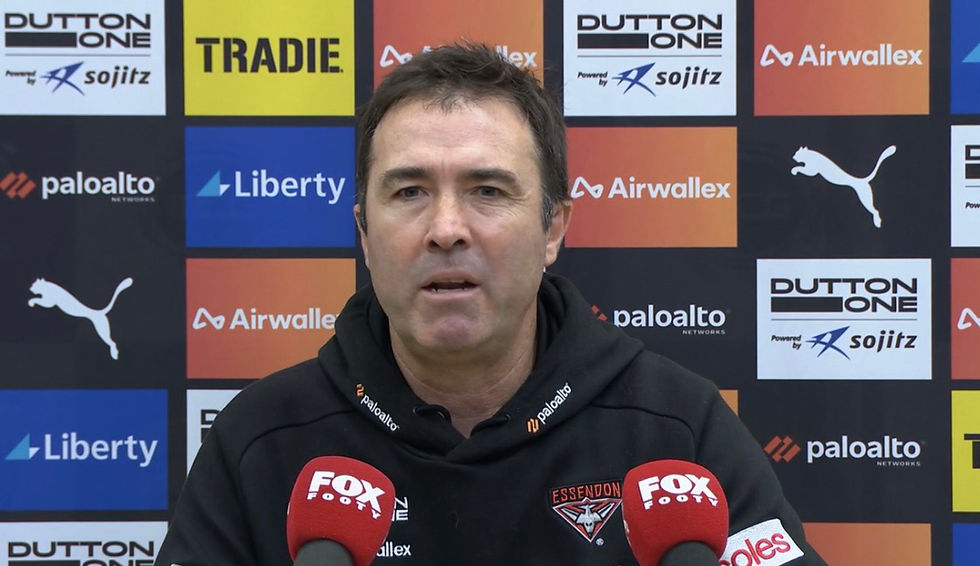
Brad Scott talking about Sullivan Robey in his post match press conference. (Vision AFL)
“He’s just such a great competitor. You know, to your point about the contest, you’ve got an 18-year-old who thrives in that scenario.
You shouldn't be (as a team), looking to your 18-year-olds to lead you out of that but Sullivan just continues to, he understands the game incredibly well. He doesn't need to be told something twice, he just executes.
The sky's the limit for where these guys can get to, but right now we need more support around our young players, which sounds a little bit back to front, doesn't it?

Justin Longmuir talking about how the game changed in the second half at his post game press conference. (Vision AFL)
“…people have a go at me and other coaches about talking about the contest when they think it's all about ball movement, but look at the contest numbers, first half, second half.
Contest usually gets your field position.
We are defending our front half pretty well, which has given us repeat entries, and then you play the game in your front half, and we usually score but, yeah, it was a frustrating, probably, last quarter and a half."
Short sharp KPI’s
Just over 34% of Essendon’s scoring this season has come in the final quarter, 12 goals more than their next best (the third quarter), with an accuracy rate of just under 69%. It is the only quarter in which Essendon holds a positive scoring differential.
Essendon’s opponents have scored almost 68% more than them in opening quarters this season, with the Bombers winning just one first term and holding a percentage of only 52.4 in that time.

Against high-quality opposition over the last five weeks, Essendon has allowed more than one in every three defensive 50 rebounds to travel end-to-end, almost 10% above league average during that stretch.
Essendon has now faced six finalists from last season, including six of the current top eight.
The Bombers retained possession from over 47% of inside 50 entries this week, their best rate since round five against Melbourne.
Essendon won the groundball battle between the arcs by five against the second-ranked team, having won it by six two weeks earlier against the number one-ranked side.
Andrew McGrath’s nine intercept possessions, the second most on the ground, equalled the third-highest total of his 190-game career.
Onto the next.
Inconsistency from players week to week, quarter to quarter and even at selection continues to undermine Essendon’s ability to build sustainable football, testing supporter patience but also reinforcing the scale of the task ahead.
The limitations of the senior core have been visible both in the past and again now, and when combined with what looks to be fluctuating motivation, is a mixture that is clearly impacting performance.
Increasingly, and probably pleasingly, the coaching group appears willing to acknowledge that publicly more and more.
At the same time, the emergence of recent young additions offers a glimpse into what the next version of Essendon could become.
Most seem aligned on the direction required to build something more sustainable, but alignment alone guarantees nothing in a competition where development, execution and list balance all need to come together.
Go Bombers!


Comments