


Review

Some relief?
It’s been a very tough five weeks for Essendon, unable to stand up in that time against five finalists from last year.
Across those 20 quarters there have been small periods of improvement, and at times even some success, but the challenge of putting four quarters together against this level of opposition has highlighted where improvement is needed both with the football, and even more clearly, without it.
This week presented an opportunity to test what had been learned through that difficult stretch against an opponent at a very similar starting point in its long-term build.
Unfortunately, things didn’t look promising in the early stages, and not long after, restrictions on what Essendon could fully implement only made things more difficult.
No relief.
It’s impossible to ignore the impact that four early injuries had on the overall performance, with two primarily first-rotation midfielders no longer able to fulfil their role, alongside a rebounding small defender and a high half forward, both important to Essendon’s structure and versatility.
First Sam Durham, and then not long after Jye Caldwell, both left the midfield rotations, and their absence was immediately felt in what has been one of Essendon’s biggest barometers for almost two and a half seasons.
Defending transition has not been a strong suit of the Bombers for far too long, so any field position gained from initial clearance has been the key to setting up a structure behind the ball in order to play a front half game, with the aim to make it even more difficult for the opposition to penetrate through.
Durham’s return to the midfield after a disappointing start to the season has him in arguably the best form of his 101-game career coming into this week. His last three games have seen him lead Essendon for pre-clearance contested possessions with nine, 13 and 12.
By his side in two of those games has been Caldwell, winning seven of his own three weeks ago, and five last week (he missed the game against GWS in between), as the Bombers were able to take it up to the two best clearance differential teams in the Lions and Dockers, coming out on top by four in both matches.

With Durham out of the game just eight minutes in, Richmond’s mature and big-bodied midfielders were able to get their hands on the dirty ball first, and from there, feed it backwards to a teammate in space who could make the right choice on where to go next.
Around the ground, Tim Taranto and Jacob Hopper fed the ball out to Seth Campbell, Steely Green and Sam Cumming, as Essendon’s inside-outside balance at stoppage, something I detailed last week, was shown up again.

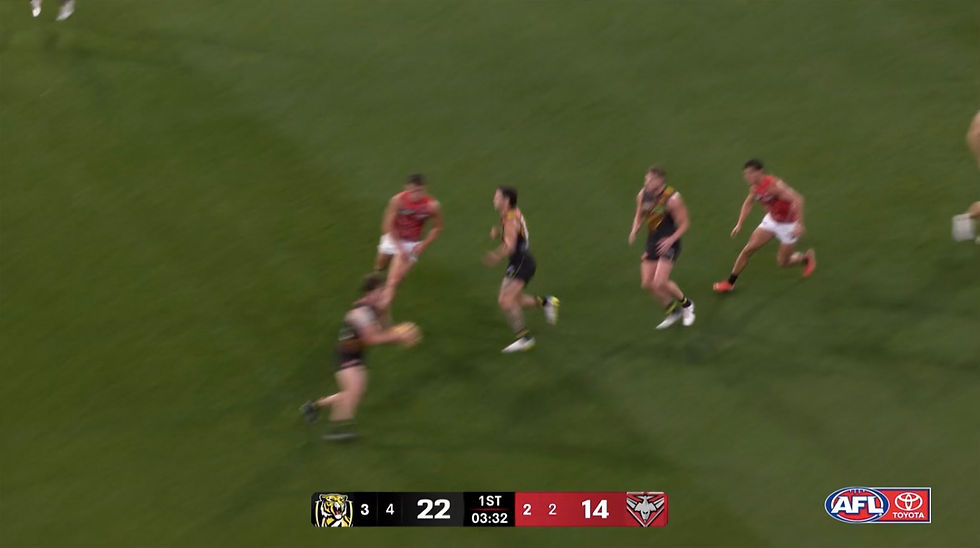
With this easy territory gain, Richmond immediately put Essendon’s defenders on the back foot. Not only did they need to stand up in contest, they were also relied upon to rebound, both areas that have been inconsistent this year, and some poor foot skills were duly punished by the Tigers in the opening 20 minutes.
Richmond’s first two goals came from Essendon back half turnovers when trying to rebound, with three of their nine shots for the quarter sourced this way.
Four versus four at centre ball ups was also an issue when Essendon lost first possession, but when they did win it, it was their primary score source for the term, with two of their four shots coming this way.
What options are there?
While there is little that can be changed structurally at centre ball ups in game, there is around the ground, as the coaches box was forced to push extra numbers at stoppage in order to limit the damage, unfortunately to little avail.
Only a third of the way through the second quarter Caldwell’s midfield influence was also gone for the night, as responsibility now fell to Archie Roberts to step in alongside Darcy Parish and seventh-gamer Sullivan Robey.
Around the ground it remained much the same.
Even with the extra Bomber, and at times two extra, around the source, Taranto and Hopper were simply too strong in pre-clearance contest.
Not only did that hurt around the ball, but especially inside Essendon’s defensive 50, with 13 of Richmond’s 20 points from stoppage coming from inside this area.
While the centre square had been Essendon’s primary score source in the first quarter, in the second they used the territory gained from their five centre clearances to establish a much more sustainable front half intercept game.
All five scoring shots for the quarter came from Richmond turnovers, with four of those coming in the Tigers defensive half.
If there was a template for how the game needed to look after the injuries, it was in this 20 minutes.
Down 10 at clearance at half time, Essendon not only had to wrestle back stoppage control, but also find a way to make it a score source.
In the second half they were able to break even at pre-clearance contests, which helped even up initial territory and provide more dangerous opportunities.
Both teams generated five shots each from stoppages, with Richmond scoring three goals two, and Essendon finishing with one goal four. In the end, 18 points was the final margin, with the Tigers outscoring the Bombers from stoppages by 22.
Thursday night, again.
Of course no one can predict the injuries that happened to both Durham and Caldwell and the flow on effects that went through the whole lineup in the reshuffle, but I still have to question selection from Thursday.
If there was a real weakness in Richmond’s game to take advantage of, and an area Essendon could have improved via selection to exploit it, it was in the midfield.
Coming into this game Richmond was the second easiest team to turn a clearance into a shot at goal against (unfortunately Essendon is the easiest), and no team gives up more points from stoppage than Richmond.
Not only should Essendon look to attack this part of the game but also use this to help their own well-known issue of defending end to end ball movement, as Richmond was the second least efficient team going from their defensive 50 into forward 50, making the front half game from stoppage even more important.
In my view, Elijah Tsatas, or at worst Will Setterfield needed to be in the lineup to not only add to midfield assets but to create flow effects where Essendon‘s most damaging players who could punish most in the front half would be able to spend more time in this area, namely Zach Merrett, Sam Durham and Sullivan Robey.
Right now, too much is being expected of key forwards to hit the scoreboard, or to have a negative effect on the oppositions most influential players. While there are times where these roles are needed, here is an opposition that is ripe for the taking, and the unpredictability of who can hurt at any given time is a better option.
Cha cha changes.
Last week I continued to share my thoughts on how Essendon is performing against certain opponents’ methods, with their better showings generally coming against teams that prefer a more chaos-based style with a higher handball-to-kick ratio, while their struggles have more often come against sides that control tempo and territory through uncontested marking.

Richmond’s profile is one that should mostly suit Essendon, as their default is to attack with run and carry, overlap handball and go quickly into a forward half that can compete in the air and scoop up any scraps before their opposition can set up defensively to slow them down.
It’s a similar style to what Essendon was able to stand up against from Gold Coast and GWS, as well as control against Melbourne.
If the plan was to deny the Tigers’ preference or go head-to-head with it, in the early stages the Bombers were nowhere near successful at either.
The chaos style relies heavily on continually winning or halving (not losing) contests, with support aided by teammates getting from one to the next. Not only couldn’t Essendon reliably compete at the initial source, they couldn’t impact even with the extra support behind the ball.
At half time, the Bombers were only down by one in post-clearance contested possessions, but it was the forward half that was inflating the numbers, while the back half was beaten by seven in such a small amount of time.
While it was promising to see Ben McKay return to some form in this area, and Kyle Langford push back early and then eventually shift back permanently and make his presence felt, Zach Reid continued to struggle as he has most of the season to win the ball back, and this has never been a strength of Mason Redman’s either, and with these issues, too much structural change is needed.
Given the injuries and the lack of rest and rotation options available, the obvious choice was to abandon the thoughts of challenging Richmond in a high transition game on the wide open expanses of the MCG, and instead force them to defend uncontested marks, so Essendon could slowly work their way up the ground, and get back to a previous version of themselves, the front half team of 2024.
With this control in tempo, Essendon found 35 uncontested marks in the back two thirds of the ground, a step up on the 25 they averaged in the first half, and the clearance game that was a losing battle disappeared, with only nine stoppages around the ground for the whole quarter.
It was a change that allowed Essendon to compete for victory in the second half, and while there are times it may work, it is one that I believe has long-term limitations.
Ain’t what it looked to be.
With this go-slow approach, too much is expected on the key forwards with little room to move, and big numbers in the air to outmark.
Nate Caddy and Archer May this week, as well as Peter Wright and Kyle Langford in other situations, can only do so much when the opposition has had time to pull support back and clog up open spaces. The game ahead of the ball lives far too much in contest and congestion, and the small forwards will struggle to use their best weapon in speed in such confined spaces.
More trust must be shown to the forwards through longer and quicker entries to one-on-ones as opposed to three-versus-four, five-versus-six as examples, and for this, the defenders need to stand up more on their own.
This looked to be the case from what I witnessed weekly throughout preseason.
Even numbers across the ground were a consistent feature, with players instructed to keep the ball in motion and move it forward quicker and longer by foot, supported by training sessions built around teammates working to leave their immediate area and get to the next contest if the ball wasn’t won in the air.
Yes, the list has huge holes in it to currently be successful with this style, as leg speed in the right positions is a bare minimum requirement, but over coming weeks I will give my explanations on why some role changes may be short-term answers, and in some cases even long-term ones.
Short sharp KPI’s
Darcy Parish’s Yiooken Medal for best on ground was well deserved through his 43 possessions. Eleven of those were won pre clearance, a third of what Essendon won for the game. His nine first possessions at stoppage was four more than any other player.
His outside game has been surely missed over the last three seasons, but he got back to some previous form with 18 handball receives, eight looseball gets in his 27 uncontested possessions and just under 700 metres gained.

15 Essendon players who played 70% or more game time applied two or fewer effective tackles for the game. No team this year has had fewer effective tackles per opposition possession than the Bombers.
Coming into this game, Richmond ranked 18th for turning an inside 50 entry into a score at 40%. Number one was St Kilda at 49.4%. This week the Tigers went at 58.5%, their best return for the year.
There were only 139 groundball wins for the game, 94 of them looseball, both the lowest in any Essendon game this year.
The clock keeps ticking.
Injuries never happen at the right time, but for a side desperate for reward after 12 months of work, four major losses to the starting 18 across the last fortnight has badly hurt what looked genuine opportunities to bank important wins.
Upstairs the pressure rightly continues to build. The key decision makers around selection, list management and the overall direction of the football club have some important decisions looming as the second half of the season approaches.
Go Bombers!


Comments