


Review

What a week it has been.
A club that had continued to speak publicly about patience, long-term growth and process has now made a dramatic change in the last seven days, with Brad Scott’s exit shifting attention well beyond weekly performance and onto the broader direction of the football club itself.
Even so, a game still sits within all of this, with Essendon heading to Perth to face West Coast in what may be a timely opportunity to step away from the external scrutiny and return focus to on-field tasks.
As has been the case for much of this season, there was a mix of positives but far too many negatives. Here’s the good with the bad.
Stoppage.
No part of Essendon’s game has been more inconsistent this year than at restarts, with the Bombers coming into this game having lost the battle in seven of their previous 11 outings. Against West Coast, however, they produced their best performance in this area since Dreamtime last year, equalling their biggest differential across the last 14 seasons.
Inside the bubble, Essendon won pre-clearance contests by 28, an enormous turnaround on their season average of -2.8, which ranked 13th in the competition coming into the round.

Winning that initial battle was only one part of the equation. The next challenge was turning that hard work into effective exits against an opponent ranked fourth for denying them this season.
Forty times Essendon converted that initial ball winning into a clearance, comfortably their best rate since the beginning of 2023, while handing West Coast its second-worst result of the season in this area, behind only Geelong in round five.
At the centre of it all was Sullivan Robey.

In just his eighth AFL game, the 19-year-old won 12 contested possessions pre clearance, the most of any player on the ground and the third most of any player this round, behind only Peter Ladhams and Patrick Cripps.
Nobody got their hands on the ball first from a ruck hitout more often than Robey, converting eight of his nine first possessions into clearances. That followed an 83.3% conversion rate against Fremantle two weeks ago and 80% last week.
Since round eight, only nine AFL players who have played more than three games in that period have averaged six or more first possessions and converted them into clearances more efficiently than Robey’s 78.1%, and none of them are under 21 years of age.
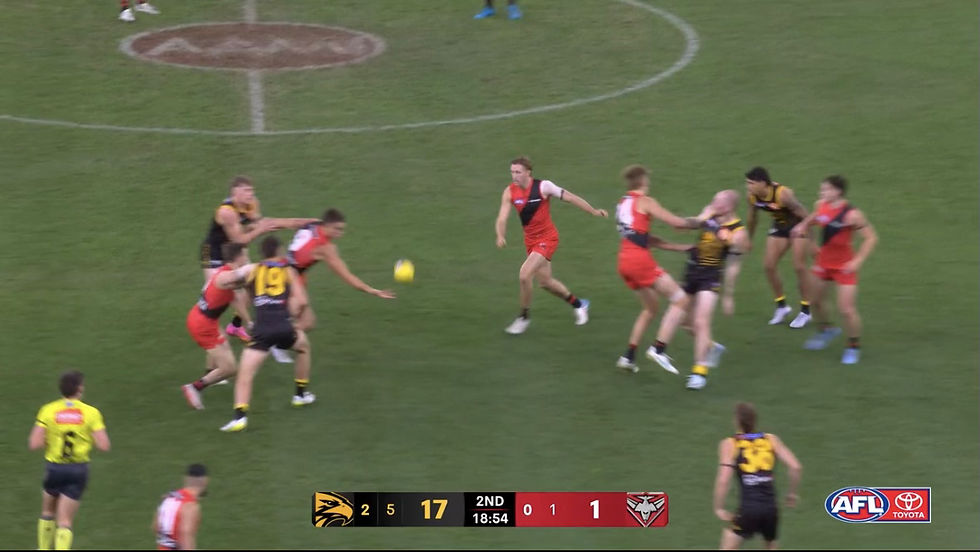
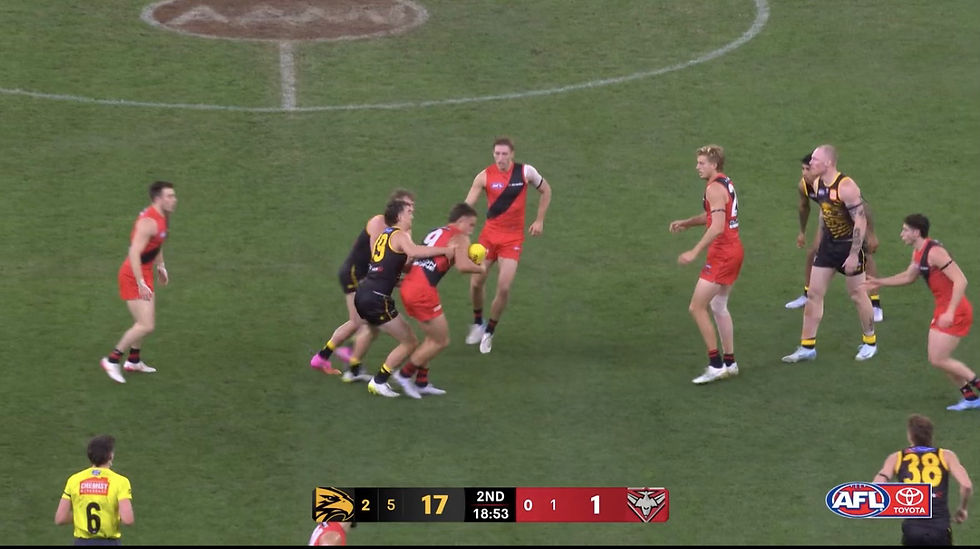

Alongside Darcy Parish and Elijah Tsatas, who won nine and six pre-clearance contested possessions respectively, the expectation was that Essendon’s dominance at the source would deliver two major rewards: territory and scores.
While initial field position helped, it couldn’t be kept, and nowhere near enough of the +22 clearance advantage translated to the scoreboard.
Essendon’s return of 11.1% clearance-to-score was its worst across the last 35 games and well down on its season average of just over 22%, with the AFL average sitting at 23.6%.
But this efficiency was largely affected by what happened further up the ground.
When Essendon did get the ball moving in the right direction, they couldn’t consistently keep what was won. At times this was due to poor skills and system in linking up and carrying the ball forward, instead just kicking — sometimes blasting — by foot. On other occasions, teammates ahead were unable to win, or at the very least halve (not lose) contests to keep it in the vicinity. Either way, possession turned over too quickly and too easily.
Conversely, when West Coast rebounded, they were far better at keeping the ball in their front half, either through repeat intercepts or by forcing another restart. Not only did that send Essendon’s midfielders back to work, it also meant the ball had further to travel to generate the same scoring opportunities.
By game’s end, the Bombers had kicked three goals from front-half stoppages, while the Eagles finished with four goals one from theirs.

Contests.
Essendon’s front half has undergone significant change in less than 12 months, either through injury or player shuffling due to inconsistency and structural balance. For the most part, the changes for the tall targets have worked in the air, but this week they weren’t up to the standards they’ve set previously, some of that incidental.
Seventeen minutes into the first quarter and Archer May’s injury was always going to be hard to cover.
Together with Nate Caddy, the two had combined to average 7.1 contested possessions in the front half, only behind the pairings of Josh Treacy and Patrick Voss from Fremantle, Aaron Naughton and Sam Darcy from the Western Bulldogs, Aaron Cadman and Jake Stringer from GWS, Nick Larkey and Jack Darling from North Melbourne and Mitch Lewis and Jack Gunston from Hawthorn.
Of those players named, only Josh Treacy, Mitch Lewis and Sam Darcy would average more contested marks than May, and without this aerial presence, and the ability to follow up at ground level (May averaged the third most tackles of all key forwards, behind only Mykelti Lefau of Richmond and Patrick Voss), too much was left to Caddy with the aid of Tom Edwards and in his new role as a forward in Ben McKay.
Kyle Langford was switched back this week, to very good effect, but McKay wasn’t able to influence enough to cover for May, and Edwards had a game he would prefer to forget quickly.
Reuben Ginbey won eight contested possessions behind centre, with his teammates Tylar Young six and Rhett Bazzo five, clearly outpointing their match-ups in crucial moments.
From here, West Coast were able to bounce out from any danger and transition too easily between the arcs, immediately putting the Essendon defenders under pressure.
As has been the case for much of the season, the Bomber talls were unable to stop their opponents or intercept to get it going the other way.
Jake Waterman made Lachie Blakiston look like the part-time defender that he is, with seven marks inside 50, the equal most of any player this round, while Jobe Shanahan added another two himself, leaving Langford the heavy task of intercepting when he could — and, as he showed through rounds five and six, he was up to this challenge.
Even though the final contested possession count finished in Essendon’s favour by two, once the ball got out of stoppages (remember they won pre-clearance contests by 28), around the ground they were easily beaten by 26 against a West Coast side ranked 13th in this metric, only one spot higher than Essendon.

Short sharp KPI’s
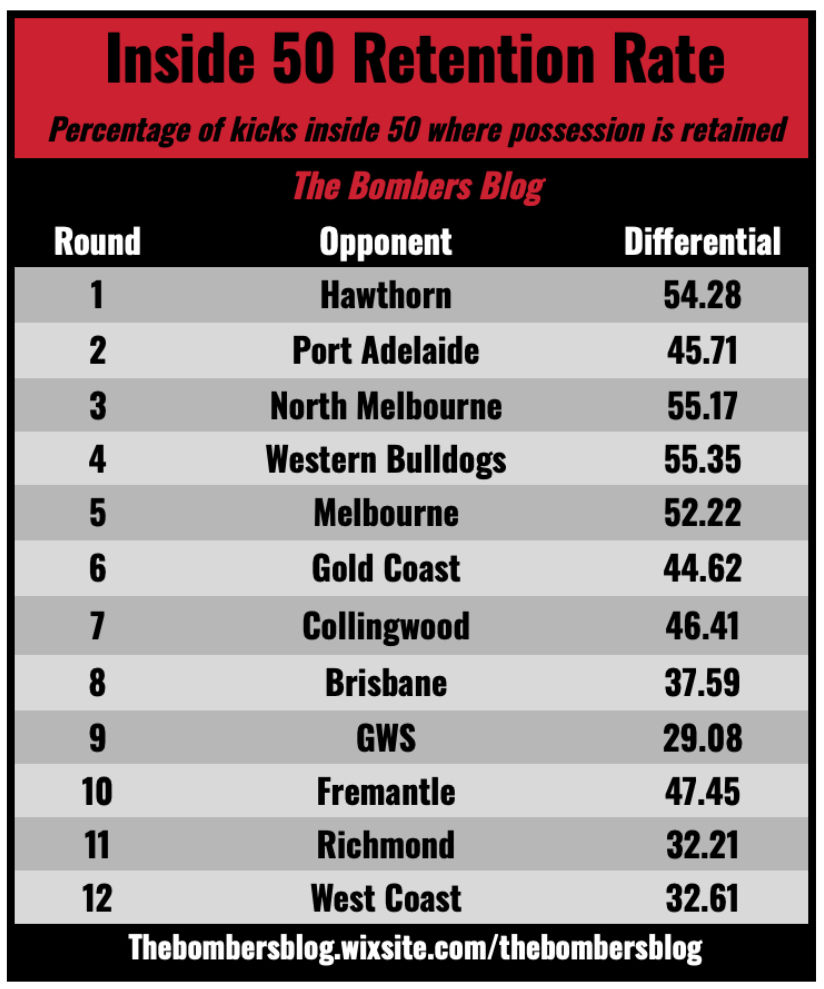
Essendon’s forward 50 retention rate of 32.61% of entries this week is their second lowest this season, behind round nine’s 29% against GWS. The AFL average after round 12 is 47.6%. In their first five games, they exceeded that average in four of them; since then, only once, against Fremantle in round 10.
The Eagles only averaged 108.8 handball receives up to this game, the 16th most of all teams; this week they had 143.
With the wind in quarters two and four, Essendon could only intercept West Coast every 5.85 possessions, while in quarters one and three, the Eagles were able to intercept every 3.8 Bomber possessions.
West Coast scored four goals six from back-half turnovers, while Essendon scored just three points.
Another week gone.
I have no issues whatsoever with the Essendon board replacing Brad Scott, as almost all of my defensive metrics over the last two seasons have worsened (yes, I understand the second half of last season was impacted by injuries, but if you’ve read my 2025 season review, you’ll know I split the season up pre-round 11 and compared it to the two previous seasons under his regime).
While all associated were aligned in what was required long term to compete against the competition, turning that vision into high-level performance is another matter, and all stakeholders were right to question his capability.
The only part I take issue with is the timing.
Understandably memberships are down as well as attendances, all hurting the club financially, but only one more home game was left before the mid-season bye, and in my view this period would have been the more appropriate time to make and communicate the decision.
The two-week break would have been a better fit for replacement coaches to plan and strategise for what needed to happen upstairs and, importantly, downstairs, allowing them to better handle the upcoming assignment.
Whatever has been done now, another short chapter has ended in Essendon’s history, a short sharp one will be written in the next 12 weeks, with hopefully a more meaningful one to follow.
Go Bombers!


Comments