


Review

Opposite momentum.
Performances have really dropped away in recent weeks, with injuries, form, and disruptions off-field all impacting at the wrong time for a young and inexperienced Essendon side.
On the other hand, Carlton’s change in direction has sparked a resurgence, and now the two arch-enemies meet with momentum heading in opposite directions for the annual King’s Birthday clash at the MCG.
Would anything change here?
Q1.
• In the previous three games under caretaker coach Josh Fraser, Carlton had gone by foot 57.75% of the time. In the opening term this week, Essendon was able to apply pressure at the source, forcing them to handball much more, with only 47.52% of their disposals being kicks.

• Essendon finished the quarter +11 in contested possessions, with Elijah Tsatas, Nick Bryan, Sam Durham, and Will Setterfield leading the way pre-clearance with 12 in total.
• From 14 inside 50s, Essendon took four marks and retained possession another 29% of the time on entry. Their 57% retention rate was 13% above their season average, which had been ranked 16th across the previous 12 games.
• The Blues had been able to convert a first possession at stoppages into a clearance just over 70% of the time coming into this game. In the first quarter, the Bombers held them to 58%.
• Patrick Cripps was the eighth-ranked midfielder for clearances around the ground up to Round 12. The Brownlow Medalist had zero at this point of the game.
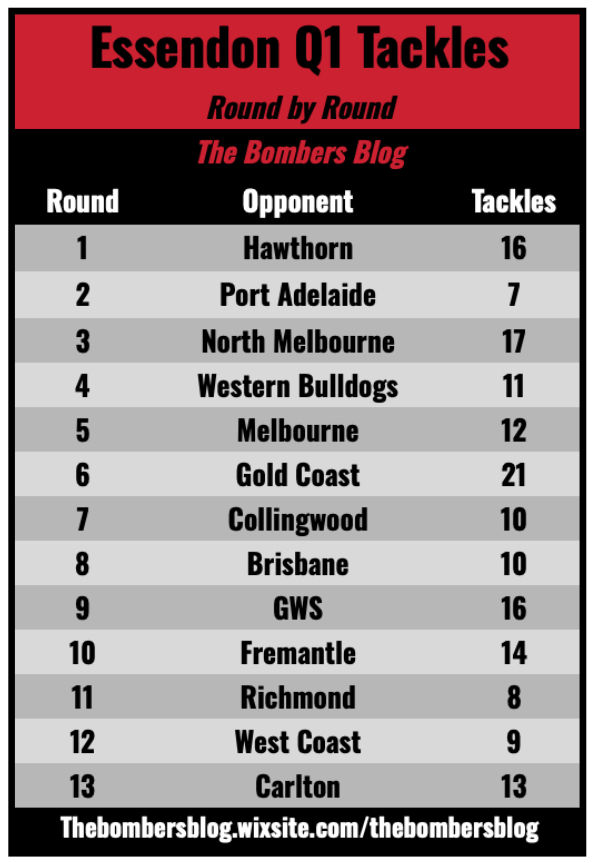
• Essendon’s 13 tackles were its sixth-highest return in the opening 20 minutes of a game this season. Sullivan Robey led the way with three at pre clearance. Since Round 9, no Bomber has averaged more in this area than the 19-year-old.
• The Bombers started with the ball 29 times for the quarter, six more than Carlton. It was the biggest possession-chain differential recorded by either side in any term this season.
• Carlton’s only goal of the term came from a kick-in. In fact, every Blues score originated from a back-half chain. Only three times this season has Essendon prevented an opposition goal from a kick-in.
• Four of Essendon’s five scores came from back-half turnovers. That is the equal-most they have scored in a first quarter, with the only other occasion coming against Melbourne in Round 5.
• For only the second time this season, Essendon won an opening quarter. The previous occasion came in Round 5 against Melbourne.
Coming into this game, the Bombers had trailed by an average of just under 15 points at quarter time. It was also just the third time they had won the inside-50 count in the opening term.

Q2.
• After dominating clearances around the ground nine to five in the first quarter, Essendon won centre clearances six to one, with one of their goals from stoppage coming from the centre square.
• In the first 20 minutes, 27.5% of the Bombers' possessions were contested, but in the second 20, 37.7% needed to be won this way. Conversely, the Blues only had to win 28%.
• By half time, Essendon had won the groundball battle both pre and post clearance, as well as across the back two-thirds of the ground. They also finished +5 in hardball gets against a Carlton side ranked fourth in this metric, while the Bombers entered the round 16th.
• In their previous three victories, Carlton had averaged 19.8 uncontested marks in transition from defensive 50 to inside 50 per quarter. Essendon restricted them to 20 in the opening term, before conceding 34 in the second, the third most they have allowed in a quarter this season.
• Essendon generated 13 inside 50s for the quarter. Their total of 27 for the first half was the equal fourth most they have recorded in any opening half this season.
• Zach Reid came into the game averaging 3.41 intercept possessions per match. By half time, he already had five.


• Five of Carlton’s scores for the quarter originated from Essendon turnovers.
• Carlton generated seven scoring shots from just 13 inside 50s, but only one came from a mark inside the area.
• Seven of Carlton’s first 10 shots at goal originated from Essendon’s front half. No side in the AFL allows more opposition points from this part of the ground than the Bombers.
Q3.
• After the first two quarters, Essendon averaged 30.5 possession chains, eight more than Carlton. In the third term, they started with the ball just 24 times, three fewer than the Blues.
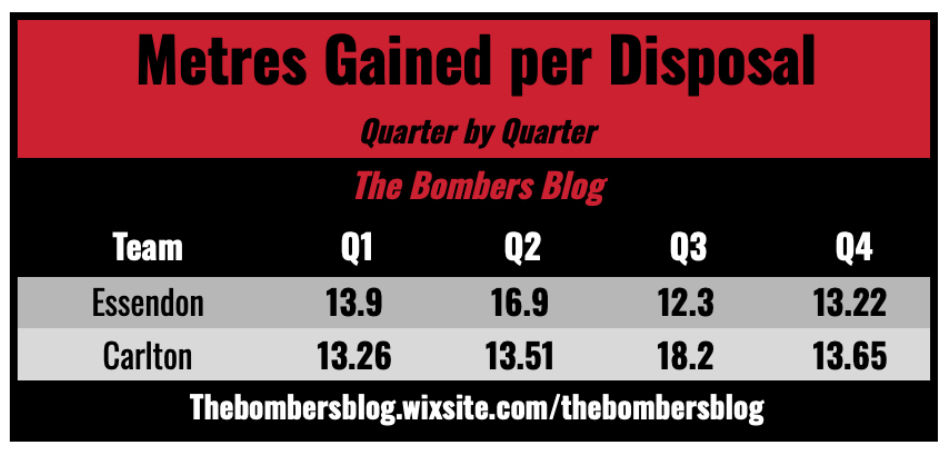
• No team averages fewer metres per disposal than Essendon this year. In the first half they averaged 15.4 (which would still rank 18th), but in this quarter that dropped to 12.3. Conversely, Carlton averaged 18.2.
• Carlton had 18 intercept possessions for the quarter, six of which were intercept marks, as they continued to lead this metric by five (11–16) with a quarter remaining.
• After winning seven contested possessions, including six pre-clearance, Sam Durham had none in this quarter, with his influence reduced significantly after going from six score involvements to zero while being tagged by George Hewett for much of the term.


• Essendon managed only six effective tackles for the quarter, following on from 25 in the first half. That equals their second-lowest return for any quarter this season, alongside Q4 against Collingwood on Anzac Day (their lowest being three against Port Adelaide in Q4).
• From only nine inside 50s, Carlton generated six scoring shots, four of which came from Essendon turnovers.
Q4.
Essendon gained only 1005 metres with the ball, well below their season average of just under 1400 per quarter (ranked 17th)
• In the second half, Essendon’s average metres gained per possession was 12.76.
• From only seven clearances, the Bombers generated three shots on goal, but were unable to convert any for maximum points.
• Essendon started with the football only 19 times. Combined with Carlton’s 22, the 41 possession chains were the least of any quarter in an Essendon game since the start of 2025.

• Across the first three quarters, Essendon averaged an intercept every 6.11 Carlton possessions. In the final term, it was 8.6, with the Bombers winning the ball back only 10 times this way.
• After six tackles in the previous quarter, Essendon added just eight more in this term.
• In his first three quarters, Nate Caddy had only two possessions — both contested, including one intercept — with no score involvements. In the final quarter, he had four possessions, all of which were involved in scoring chains, including a goal and a goal assist
More KPI’s
• From 17 forward-half intercepts, Essendon generated only two shots at goal.
• Essendon’s forward 50 retention rate of 46.8% was their second-best since their Round 5 victory. Since that point, they had averaged 38.56%, clearly the lowest in the competition.

• Heading into this game, Carlton ranked 4th for groundball between the arcs (+2.25), while Essendon was 15th (-2.41). This week, Essendon won that battle by 18.

• Last week, Essendon were soundly beaten at post-clearance contests by 26. This week they turned it around, winning the count by 15.
• Essendon only had three one-on-one contests in the front half, well below the AFL average of 10 per game. That follows on from five the previous week, with a season high of 17 against GWS and 15 against Gold Coast. Carlton, by comparison, had 10.

• 15 Essendon players laid one tackle or less for the game
• Reid’s 19.4 AFL Player Rating points was his highest in his 32-game career.
• Durham’s 12.3 AFL Player Rating points in the second quarter was the highest of any Essendon player this season.
An eye on what’s to come.
Victory was genuinely within Essendon’s grasp for the whole game, something that hasn’t been the case consistently over the past 12 months. While a win would have been a significant reward for what has been an extremely difficult and trying season to date, the default focus has to remain on continued development.
It’s hard to place too much blame on what has been, in effect, a rushed couple of weeks following the sacking of Brad Scott, with the scramble in coaching changes likely shifting attention away from on-field priorities. That said, it only reinforces my view that the timing of the decision, just weeks out from the bye, was far from ideal.
With one game left before a much-needed break, the second half of the season needs to revolve around the future core of the club — the players around whom long-term success is being built — and ensuring the game style gives them the best opportunity to show why they were drafted.
The high-possession, slow, indirect style of recent seasons, in my view, has had too strong an influence on the development of previously highly rated draftees, with natural instincts from their junior years being reined in. That has created hesitation and confusion at times, and ultimately hasn’t aligned with either their natural traits or the way the modern game is played.
A greater emphasis on controlled chaos with space to work in would provide a clearer picture for coaches of what players are truly capable of under real game pressure. At the moment, too much is expected in congestion, which doesn’t fully reflect their strengths. For some already on the list, those habits may already be ingrained, but for others there is still time to change course.
Contested ball winners need the opportunity to show their potential against the best on game day. Forwards should be given the chance to combine their natural ability with what is trained during the week in genuine space against experienced defenders, and skilled ball users must be encouraged to demonstrate their decision-making and execution through faster ball movement.
More trust has to drive the next wave of talent.
Over the pre-season I reviewed a change in methodology with the football, placing greater emphasis on contests ahead in one-on-ones and increased fitness demands, with players instructed to outwork their matchups and push forward for support at the drop of the ball if a mark wasn’t taken.
Preseason training report.
For the most part, that has been missing across the season, aside from isolated quarters and matches against Gold Coast and more recently GWS, both of which represent Essendon’s better performances this year.
There will be times when the wrong decision is made on who to kick to and where, and turnovers will hurt. In other moments, more mature bodies will stand up and win the hard ball, and forwards will lead to the wrong spots and not reliably connect with teammates — but let them learn on the job, because there’s only so much that can be replicated during the week.
Go Bombers!


Comments